Introduction
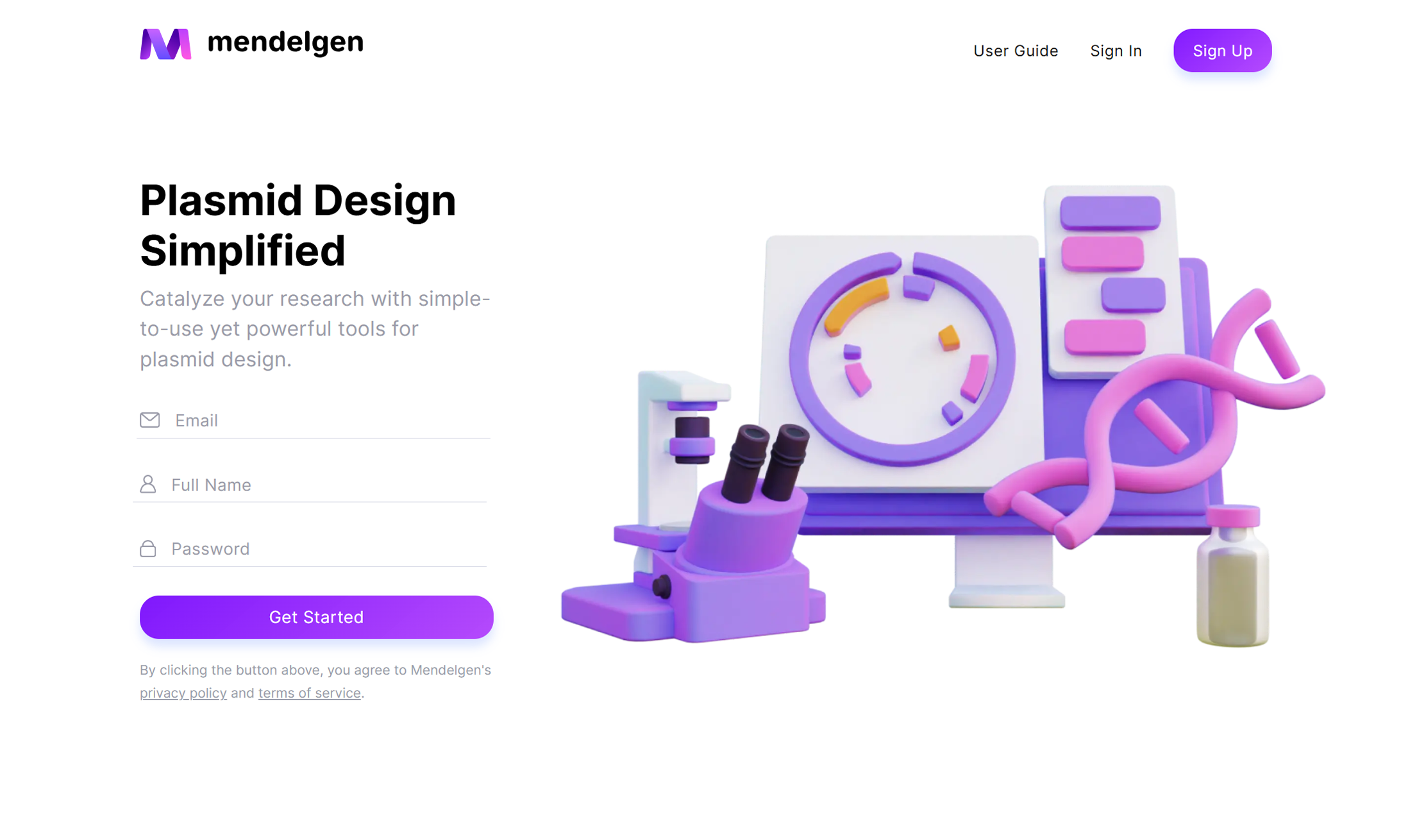
Mendelgen is a modern plasmid editing and bioinformatics platform designed to accelerate genetic research and biotech innovation. By combining intuitive visualization tools with advanced molecular biology workflows, Mendelgen empowers researchers to design, edit, and analyze plasmids without the complexity of traditional desktop bioinformatics software.
The platform supports use cases such as cloning design, sequencing alignment, and vaccine development, offering scientists an accessible yet powerful environment to streamline their research pipelines.
Key Features
- Plasmid Editor & Visualization: Interactive plasmid maps with drag-and-drop editing for genes, promoters, and regulatory elements, making genetic design both visual and intuitive.
- Cloning & Construct Design: Tools to simulate cloning strategies, design restriction enzyme digests, and preview resulting constructs in real time.
- Sequencing Alignment: Integrated sequence alignment capabilities allow researchers to validate constructs against experimental sequencing data.
- Vaccine Design Tools: Specialized modules for epitope prediction, immunogenicity analysis, and synthetic construct optimization tailored for vaccine R&D.
- Collaboration & Sharing: Easy project sharing with colleagues, export options for plasmid maps, and streamlined integration with external lab workflows.
Technical Insights
- Frontend: Developed with React, Next.js, and TypeScript, the frontend delivers a performant, responsive, and modular user experience. Material UI (MUI) provides a clean and accessible design system, with custom extensions for domain-specific bioinformatics visualizations.
- Backend & APIs: A Node.js backend orchestrates API requests and integrates with Python-based bioinformatics modules that handle computational workflows such as cloning simulation, restriction mapping, and sequence alignment.
- Bioinformatics Engine: Powered by optimized bioinformatics algorithms, the engine performs high-accuracy sequence parsing, alignment, and construct validation. These algorithms are written in Python for computational reliability and extensibility.
- Database & Persistence: Core data such as plasmids, annotations, and project metadata are stored in PostgreSQL. Redis is used as a caching layer for performance-intensive operations like alignment results and large visualization datasets.
- Visualization Layer: Interactive genome and plasmid maps are rendered with scalable vector graphics (SVG) for smooth zooming, panning, and real-time editing interactions.
- Scalability & Deployment: The platform is hosted on AWS, leveraging EC2 for compute, S3 for sequence storage, and RDS for managed databases. This cloud-first architecture enables Mendelgen to scale seamlessly for research teams and large biotech organizations.
Challenges and Solutions
- Complex Data Visualization: Rendering large plasmids with multiple annotations posed performance challenges. The solution was implementing virtualized rendering with SVG layering to ensure smooth user interactions.
- Accuracy in Bioinformatics Operations: Sequence manipulation errors could compromise scientific results. To mitigate this, we implemented extensive validation layers and automated test suites that cross-check alignment and cloning outputs against reference datasets.
- User Experience for Scientists: Most researchers are not software engineers, so a steep learning curve would hinder adoption. Mendelgen addresses this with intuitive UI patterns, contextual tooltips, and streamlined workflows that reduce complexity without sacrificing power.
- Collaboration Across Teams: Biotech projects often involve cross-disciplinary teams. To support this, we built project sharing and versioning tools, ensuring data consistency and enabling seamless collaboration.